
NBFC vs Bank in India: Understanding the Right Loan Choice for Your Financial Needs
By Cashfast Finserv
Finding the right loan is not just about securing funds. It is about choosing the right lending partner that aligns with your financial goals, repayment capacity, and urgency.
When exploring financing options in India, borrowers typically come across two major sources of credit: Banks and Non-Banking Financial Companies (NBFCs).
Both offer personal loans, business loans, home loans, loan against property, and other credit products. However, their lending approach, approval process, eligibility criteria, and customer experience can differ significantly.
Understanding these differences can help you make a well-informed borrowing decision and improve your chances of obtaining financing that suits your requirements.
Understanding Banks and NBFCs
What is a Bank?
A bank is a regulated financial institution authorized by the Reserve Bank of India (RBI) to accept deposits, provide loans, and offer a wide range of banking services.
Banks are often preferred by borrowers seeking competitive interest rates, long-term financing solutions, and a traditional banking relationship.
Popular examples include State Bank of India (SBI), HDFC Bank, ICICI Bank, Axis Bank, and Punjab National Bank.
What is an NBFC?
A Non-Banking Financial Company (NBFC) is a financial institution registered with the RBI that provides lending and financial services but does not function as a traditional deposit-taking bank.
Over the last decade, NBFCs have transformed India's lending landscape by offering faster approvals, simplified documentation, digital onboarding, and greater accessibility to underserved borrowers.
Leading NBFCs include Bajaj Finance, Tata Capital, Aditya Birla Finance, and Muthoot Finance.
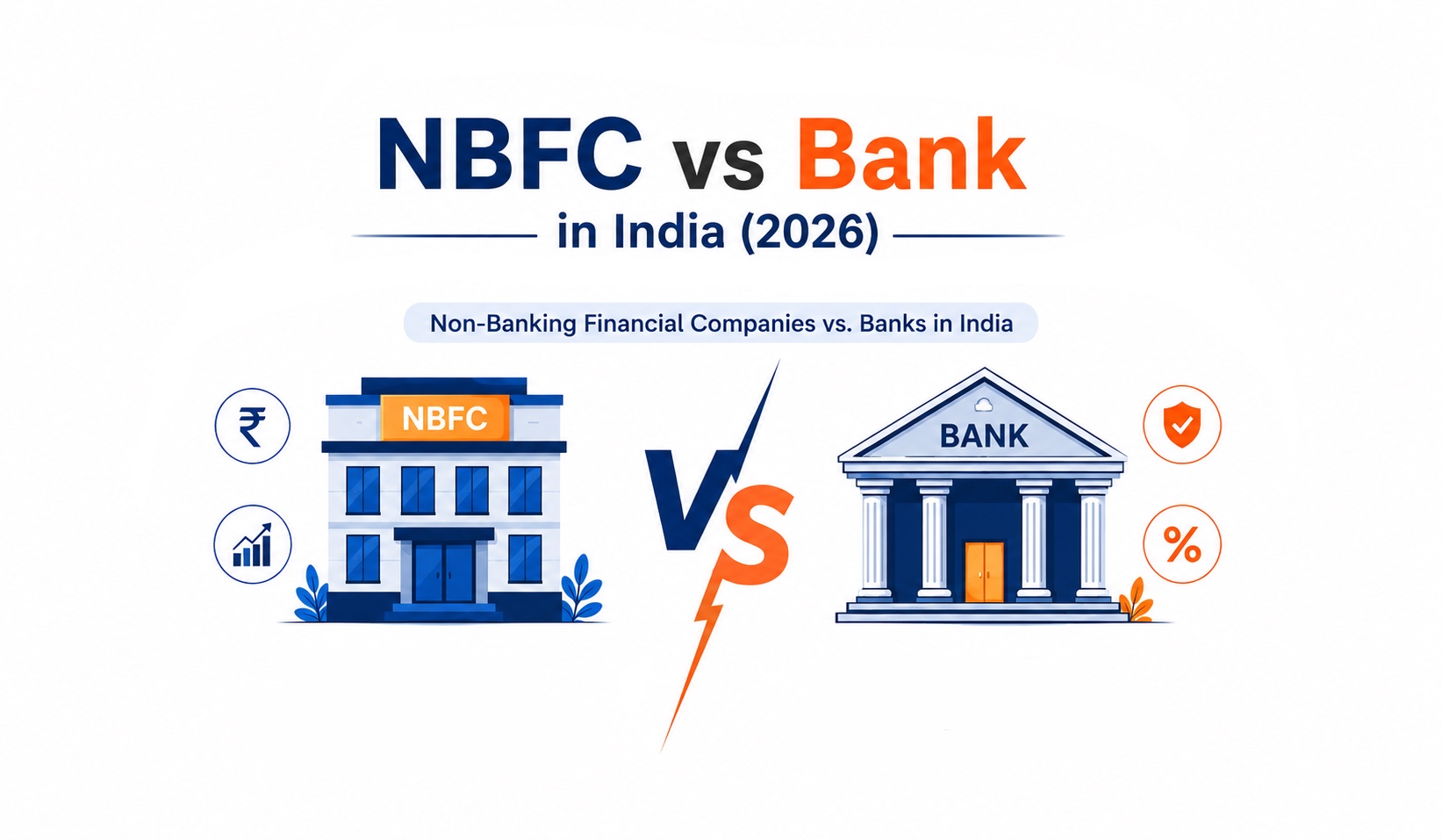
Bank vs NBFC: Key Differences Every Borrower Should Know
Loan Approval and Processing Time
One of the most noticeable differences lies in the speed of loan processing.
Traditional banks generally follow comprehensive verification procedures, making approvals relatively slower. While this strengthens risk assessment, it can extend processing timelines.
NBFCs, on the other hand, have adopted technology-driven lending models that enable faster application reviews, instant eligibility checks, and quicker disbursals.
For borrowers facing urgent financial requirements, speed can become a critical deciding factor.
Eligibility Requirements
Banks typically follow stricter underwriting standards and prefer applicants with strong credit scores, stable income, and well-documented financial records.
NBFCs often adopt a more flexible approach and may cater to:
- Self-employed professionals
- Freelancers
- Small business owners
- First-time borrowers
- Individuals with limited credit history
This broader accessibility has contributed significantly to financial inclusion across India.
Interest Rates and Cost of Borrowing
Banks generally offer lower interest rates due to their access to lower-cost funds and established lending frameworks.
NBFCs may charge slightly higher rates in certain cases, reflecting the additional flexibility and wider risk coverage they provide.
However, borrowers should evaluate the complete borrowing cost, including:
- Processing fees
- Prepayment charges
- Repayment flexibility
- Approval probability
rather than focusing solely on interest rates.
Documentation and Application Experience
Many borrowers find bank loan applications document-intensive.
Verification requirements may include:
- Income proofs
- Employment records
- Bank statements
- Tax returns
- Detailed KYC documentation
Most modern NBFCs have simplified this process through digital onboarding, paperless applications, electronic verification, and online document submission.
The result is a smoother and more convenient customer experience.
Which Loan Provider Should You Choose?
The ideal choice depends on your financial profile and borrowing priorities.
Consider a Bank If:
- You have an excellent credit score
- You are seeking lower borrowing costs
- You require a large loan amount
- You have complete income documentation
- You are comfortable with a longer approval process
Consider an NBFC If:
- You need quick access to funds
- You prefer a digital application process
- You are self-employed or a freelancer
- Your credit profile is still developing
- You require greater flexibility in eligibility assessment
Why Smart Borrowers Compare Multiple Lenders Before Applying
Applying to multiple lenders individually can be time-consuming and may lead to unnecessary documentation and repeated application efforts.
Today's borrowers increasingly prefer loan comparison platforms that simplify lender discovery and help identify suitable financing options through a single process.
Comparing multiple loan offers enables borrowers to evaluate:
- Interest rates
- Loan eligibility
- Processing timelines
- Repayment terms
- Approval probability
before making a decision.
How Cashfast Helps Simplify Loan Discovery
Cashfast Finserv helps borrowers explore suitable lending options by connecting them with trusted Banks and NBFCs based on their profile and requirements.
Rather than limiting customers to a single lender, Cashfast streamlines the search process and helps borrowers evaluate financing solutions more efficiently.
Whether you are a salaried employee, self-employed professional, entrepreneur, or first-time applicant, the objective is to make loan discovery simpler, faster, and more transparent.
Final Thoughts
The debate between Banks and NBFCs is not about determining which institution is universally better.
It is about identifying which option is better for you.
Banks offer stability, structured lending, and competitive interest rates. NBFCs deliver speed, flexibility, and broader access to credit.
By understanding your financial profile, repayment capacity, and funding requirements, you can choose the lending partner that best supports your goals and borrowing journey.